To learn more about the types of training and consultation that BTECH offers, visit our Training Catalog here.
Interested in a training that is sold out? Please join our Waiting List so we can contact you as we schedule future events.

- This event has passed.
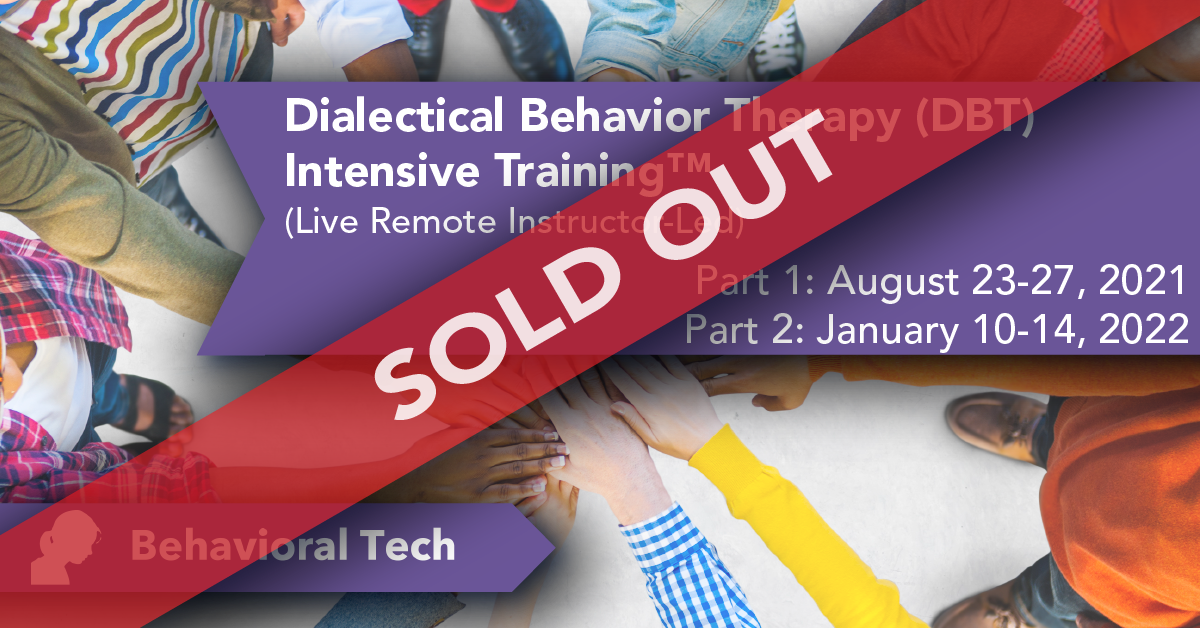
Dialectical Behavior Therapy Intensive Training (Sold Out!)
Level 3
Live, Remote, Instructor-led
Part 1: August 23-27, 2021
Part 2: January 10-14, 2022
Trainers: Gwen Abney-Cunningham and Donna Pattie
Training Description
Training Description
Since its initial development in the 1980s DBT has been shown to be effective for an array of problems related to emotion dysregulation. We know severe emotion regulation difficulties result in persons facing multiple problems across many areas of life and that these problems manifest in a variety of ways. The principles of DBT were specifically designed for cases which often present therapists with novel challenges. One of the benefits of a principle-based treatment is that it can be versatile enough to accommodate the specific situations, cultures, and contexts of the persons it serves. DBT has been studied and implemented in multiple countries across the globe.
DBT Intensive training is a comprehensive team-based program of study designed to provide teams with the knowledge and skills necessary to provide DBT. It focuses on both the establishment of comprehensive DBT programs and the clinical skills necessary to provide the treatment to persons with complex mental health problems. Intensive training in DBT includes 4 hours of content specific to risk assessment, management, and treatment of suicidal behaviors.
The program is divided into 2 parts that are designed to guide teams to accomplish four phases of DBT program implementation. While Parts 1 and 2 are described separately, they comprise a single program of study.
Part 1 (30 instructional hours)
- Preparation
- Knowledge Acquisition
Part 2 (30 instructional hours)
- Implementation
- Practice Improvement & Sustainability
In Part 1, lectures, demonstrations of treatment, and small group exercises are used to teach DBT theory and strategies in-depth. Upon conclusion of Part 1, participants consolidate and apply what they have learned with the help of practice assignments that are intended to guide the implementation process. Teams design and begin to implement their own DBT programs or to integrate DBT into an ongoing treatment setting. In Part 2, each team presents their work and receives expert consultation on specific cases and on their program, including protocols for specific treatment problems and adaptations of DBT.
This live remote instructor-led program of study consists of 10 days of training, divided into 2 parts of 5 days each, delivered via video conference embedded in a learning management system (LMS) for a total of 60 instructor-led hours. The typical length of the full course of study is 6 months to 1 year.
Primary Objective:
As a result of this training participants will be able to provide DBT.
Part 1 – Learning Objectives:
- Incorporate DBT assumptions about clients, therapists, and therapy into treatment.
- Balance change and acceptance in providing consultation.
- Apply DBT principles and strategies during DBT consultation team meetings.
- Increase the motivation and capability of therapists on your consultation team.
- Describe how the scientific method is used in both treatment development and conducting DBT.
- Use DBT research data to engage stakeholders in DBT.
- Adopt and practice a dialectical worldview in treatment and case formulation.
- Engage clients in treatment by providing dialectical balance between change and acceptance.
- Accurately describe the content of the skills training module: Core Mindfulness.
- Convey the rationale for DBT Mindfulness skills.
- Explain how Core Mindfulness skills are key (core) to all skills taught in DBT.
- Explain the Biosocial Model of Borderline Personality Disorder (BPD) and other severe disorders in all required treatment contexts.
- Conceptualize the manner in which suicidal behavior is an attempt by patients to solve problems.
- Incorporate hypotheses to include in DBT case formulation based on dialectical dilemmas experienced by persons with borderline personality disorder (duplicate).
- Accurately describe the content of the skills training module: Emotion Regulation.
- Describe the evidence for the use of DBT Emotions Regulation skills.
- Convey the rationale for DBT Emotion Regulation skills.
- Describe the functions of comprehensive treatment and the corresponding modes employed in DBT to accomplish these functions.
- Describe how levels of disorder and stages of treatment guide treatment planning and targeting.
- Identify client’s life goals that can be used as motivation for engaging in DBT.
- Structure treatment according to the target hierarchies for each modality (e.g., individual, skills training, phone).
- Set target hierarchies for clients with multiple problems.
- Complete DBT pre-treatment tasks (e.g., identify client’s goals, orient to DBT, obtain commitments).
- Describe the key elements that should be addressed in individual DBT sessions.
- Structure individual DBT sessions.
- Describe the function of DBT skills training.
- Define the roles of the leader and co-leader in DBT skills training.
- Explain how to structure a DBT skills training class.
- Identify the contents of the DBT Interpersonal Effectiveness skills module.
- Describe the evidence for the use of DBT Interpersonal Effectiveness skills.
- Convey the rationale for DBT Interpersonal Effectiveness skills.
- Identify the contents of the DBT Distress Tolerance skills module.
- Describe the evidence for the use of DBT Distress Tolerance skills.
- Convey the rationale for DBT Distress Tolerance skills.
- Define problem behaviors specifically and behaviorally.
- Conduct a chain analysis of an episode of a target behavior.
- Conduct missing links analyses of needed behaviors that did not occur.
- Describe the DBT problem-solving strategies (skills training, cognitive modification, exposure, contingency management).
- Generate and evaluate solutions for specific problematic links from a chain analysis.
- Describe the use of validation in DBT.
- Implement the levels of validation in DBT.
- Engage clients in treatment by providing dialectical balance between change and acceptance.
- Employ the dialectical strategies in DBT.
- Implement DBT stylistic strategies (reciprocal and irreverent communication).
- Assess long-term and acute risk for suicide.
- Talk with individuals in a manner that facilitates assessment of suicide risk.
- Describe the steps involved in crisis management.
- Apply DBT suicide crisis protocols.
- Respond to ongoing suicidal behavior during treatment.
- Coach clients to generalize skills in all relevant contexts.
- More effectively coach clients with skills specific to their needs.
- Competently help patients employ difficult-to-use skills.
- Implement the DBT case management strategies.
- Identify the application of, and limits to, consultation to the client.
- Explain the importance of observing personal and professional limits in DBT.
- Describe the steps for observing limits in DBT.
Part 2 – Learning Objectives:
- Talk with individuals in a manner that facilitates assessment of suicide risk.
- Implement an evidence-based protocol for intervening in suicide crisis situations.
- Identify DBT skills for clients to use for specific problems in specific contexts.
- Structure team-based consultation sessions.
- Determine the best course of clinical application based on consultation and extrapolation from the evidence-base for DBT.
- Discuss the exam assigned in Part 1 and consequently better understand important concepts in DBT.
- Discuss homework assignments involving the application of the treatment and consequently better understand how to apply the treatment.
- Design DBT service programs, appropriately implementing and modifying DBT protocols for my particular setting and patient population.
- Effectively balance adaptation and adoption in implementation of DBT.
- Utilize implementation outcome variables to increase the sustainability of DBT programs.
- Conceptualize clinical cases and problems from a DBT perspective.
- Formulate cases with emotion at the heart of problem behavior.
- Engage in DBT case formulation as an iterative means of treatment planning, intervention, and measurement.
- Demonstrate the ability to apply important concepts in DBT.
- Write DBT case formulations with behavioral specificity.
- Actively participate in a DBT consultation team.
- Set targets for DBT consultation team meetings and manage time accordingly.
- Balance change and acceptance in providing consultation.
- Formulate cases with attention to the transaction of the individual-environment system.
- Incorporate the biosocial model of BPD into case formulation.
- Conceptualize the manner in which suicidal behavior is an attempt by patients to solve problems.
- Describe how levels of disorder and stages of treatment guide treatment planning and targeting.
- Link client targets to goals.
- Link client’s goals to the tasks of treatment.
- Organize DBT sessions based on a target hierarchy for each modality (e.g., individual, skills training).
- Overcome obstacles of both therapists and clients in setting treatment goals and targets before starting the treatment.
- Define problem behaviors specifically and behaviorally.
- Identify the critical variables influencing a problem behavior.
- Clarify program elements that support the functions of a comprehensive treatment program.
- Evaluate whether a DBT program addresses the 5 functions of comprehensive treatment.
- Explain the difference between chain and solution analyses.
- Conduct solution analyses.
- Identify solutions to address the critical variables influencing problem behaviors.
- Select and suggest specific skills to fit a situation or context.
- Implement the DBT problem-solving strategies (skills training, cognitive modification, exposure, contingency management).
- Evaluate the use of DBT strategies in my own and others’ cases.
- Describe the relationship between secondary targets and primary targets.
- Determine when to focus on secondary targets (dialectical dilemmas).
- Identify options for intervening in secondary targets (dialectical dilemmas).
- Identify the application of, and limits to, consultation to the client.
- Implement DBT case management strategies (consultation-to-the-client and environmental intervention).
- Generate solutions to address barriers to implementing DBT in my program.
- Demonstrate the ability to evaluate the use of DBT strategies in others’ cases.
- View and discuss DBT as modeled by expert therapists (e.g. video, demonstrations) and be better able to describe and apply treatment strategies.
- Practice the techniques of DBT via behavioral rehearsal, as coached by the instructors and be better able to describe and apply treatment strategies.
- Provide solutions when consulting that are pertinent to the problem and likely to be effective.
- Apply the treatment after my team’s case consultation.
- Apply DBT principles and strategies during DBT consultation team meetings.
- Identify team problems and use DBT strategies to resolve them.
- Employ techniques for strengthening the DBT consultation team.
- Clarify expected long-term outcomes for my DBT program.
- Identify methods of measuring outcomes for my DBT program.
Schedule
Please Note all Times Listed are in Eastern Daylight Time.
| 8:30 – 9:00 AM | Registration and Sign in |
| 9:00 – 9:30 AM | Mindfulness |
| 9:30 – 10:45 AM | Morning Session 1 |
| 10:45 – 11:00 AM | Break |
| 11:00 AM – 12:15 PM | Morning Session 2 |
| 12:15 – 1:15 PM | Lunch |
| 1:15 – 2:30 PM | Afternoon Session 1 |
| 2:30 – 2:45 PM | Break |
| 2:45 – 4:00 PM | Afternoon Session 2 |
| 4:00 – 4:30 PM | Q&A, Evaluations, and Sign out |
CE NOTE: Behavioral Tech calculates the continuing education credits for this training by the start time and end time. 100 percent attendance is required, as is signing IN and OUT each morning and afternoon, to receive CE credits. Partial credits cannot be issued.
Trainers
Gwen Abney-Cunningham, LMSW
 Kalamazoo, MI (United States)
Gwen Abney-Cunningham, LMSW, is currently a fulltime Behavioral Tech consultant and trainer. Prior to coming to Behavioral Tech full time, she was employed at a community mental health agency for 32 years, in many roles, including; DBT Services Supervisor, Outpatient Services Director, and most recently as Evidenced Based Treatment Director. Gwen received her bachelor’s degree from Hope College and her MSW from Grand Valley State University. She has 30 plus years of professional experience and is a member of one of the first teams in the U.S. to apply DBT within an ACT program. Gwen is intensively trained in DBT and an experienced workshop leader at state, national, and international conferences. Gwen continues to work as a DBT therapist because it is effective and the hope it brings to clients and their families. As a BTECH Trainer and consultant, she is also able to assist many mental health providers in learning the treatment to assist in helping many individuals.
Gwen’s experience in DBT includes individual and skills training for adults, adolescents and families and providing DBT supervision to clinicians. In addition, she has assisted in the development and implementation of DBT on ACT teams and in outpatient settings. Gwen has been involved with the large-scale implementations of DBT in Michigan for Community Mental Health settings. She has been a Behavioral Tech trainer for 20 plus years. Gwen has also served on the Behavioral Tech Trainer Advisory Committee and the Behavioral Tech Implementation Science Workgroup.
Kalamazoo, MI (United States)
Gwen Abney-Cunningham, LMSW, is currently a fulltime Behavioral Tech consultant and trainer. Prior to coming to Behavioral Tech full time, she was employed at a community mental health agency for 32 years, in many roles, including; DBT Services Supervisor, Outpatient Services Director, and most recently as Evidenced Based Treatment Director. Gwen received her bachelor’s degree from Hope College and her MSW from Grand Valley State University. She has 30 plus years of professional experience and is a member of one of the first teams in the U.S. to apply DBT within an ACT program. Gwen is intensively trained in DBT and an experienced workshop leader at state, national, and international conferences. Gwen continues to work as a DBT therapist because it is effective and the hope it brings to clients and their families. As a BTECH Trainer and consultant, she is also able to assist many mental health providers in learning the treatment to assist in helping many individuals.
Gwen’s experience in DBT includes individual and skills training for adults, adolescents and families and providing DBT supervision to clinicians. In addition, she has assisted in the development and implementation of DBT on ACT teams and in outpatient settings. Gwen has been involved with the large-scale implementations of DBT in Michigan for Community Mental Health settings. She has been a Behavioral Tech trainer for 20 plus years. Gwen has also served on the Behavioral Tech Trainer Advisory Committee and the Behavioral Tech Implementation Science Workgroup.
Additional Faculty & Presenters
Donna Pattie, MSW, LICSW

 Donna Pattie, MSW, LICSW is the DBT Trainer and Consultant for 15 DBT outpatient teams at Nystrom & Associates, Ltd across the state of MN. Donna is a Linehan Board Certified DBT therapist and DBT Team Lead in New Brighton, MN for a Linehan Board Program Certified Team. Donna supervises team members and interns and has delivered DBT in both the Adult and Adolescent/Family programs since 2011. She was intensively trained by Melanie Harned in DBT PE, and has delivered DBT PE for the last 6 years. She supervises Nystrom clinicians across MN in the delivery of DBT PE monthly. Donna has run DBT standard adult outpatient groups, a DBT Adaptive Skills group for clients with traumatic brain injury/developmental delays and a DBT SUD group for clients with co-occurring substance use disorders.
Prior to her work in MN, Donna delivered Cognitive Behavioral Therapy in an outpatient private practice in North Easton, MA and previously was the Team Lead at the Brockton VA Medical Center’s Post Traumatic Stress Disorder Clinical Team. She started her work at the VA on the Substance Use Disorder Inpatient Detoxification and Rehabilitation programs. Donna brings over 30 years of experience in the clinical field and has a passion for fidelity to DBT and training both new and experienced clinicians in the field. She received her Master’s degree in clinical social work from Simmons College School of Social Work in Boston, MA.
Donna Pattie, MSW, LICSW is the DBT Trainer and Consultant for 15 DBT outpatient teams at Nystrom & Associates, Ltd across the state of MN. Donna is a Linehan Board Certified DBT therapist and DBT Team Lead in New Brighton, MN for a Linehan Board Program Certified Team. Donna supervises team members and interns and has delivered DBT in both the Adult and Adolescent/Family programs since 2011. She was intensively trained by Melanie Harned in DBT PE, and has delivered DBT PE for the last 6 years. She supervises Nystrom clinicians across MN in the delivery of DBT PE monthly. Donna has run DBT standard adult outpatient groups, a DBT Adaptive Skills group for clients with traumatic brain injury/developmental delays and a DBT SUD group for clients with co-occurring substance use disorders.
Prior to her work in MN, Donna delivered Cognitive Behavioral Therapy in an outpatient private practice in North Easton, MA and previously was the Team Lead at the Brockton VA Medical Center’s Post Traumatic Stress Disorder Clinical Team. She started her work at the VA on the Substance Use Disorder Inpatient Detoxification and Rehabilitation programs. Donna brings over 30 years of experience in the clinical field and has a passion for fidelity to DBT and training both new and experienced clinicians in the field. She received her Master’s degree in clinical social work from Simmons College School of Social Work in Boston, MA.
Basma F. Kilani
 Amman, Jordan
 Basma Kilani, M.A., is a DBT-LBC Certified Clinician by the Linehan Institute from Amman, Jordan where she is Founder & Chief Specialist at the Maria Den Braven Mental Health Center. She is also the Managing Director of DBT-MENA, the BTECH affiliate in that region. Basma began studying DBT in 2008 as a graduate student at the University of Jordan. In 2016-17, Basma’s team completed DBT Intensive Training through British Isles DBT. In 2019, Basma was appointed DBT Ambassador in Jordan by Behavioral Tech/ Linehan Institute, Basma joined the BTECH training team as a Trainer in 2022; André Ivanoff serves as her training mentor. Basma became the BTECH Affiliate head for DBT MENA in 2021.
Basma hosted a Skillful Living Training in October 2020 , Foundational Training with Nick Salsman, and has presented in three DBT Intensives, two in the MENA region in 2020-21, and the other at Columbia University in 2021-22. Basma has a published Master’s dissertation on the prevalence of eating disorders amongst young adults in Jordan. Basma’s PhD research under Michaela Swales’ supervision is on the association between adverse childhood experiences and non-suicidal self Injury (NSSI) mediated by shame as well the implementation of DBT skills training in Jordan. She is also currently involved in survey research with 180 participants in the MENA region who have completed DBT Intensive Training. Basma is committed to the dissemination of DBT, not only in the Middle East, but across the globe.
Basma Kilani, M.A., is a DBT-LBC Certified Clinician by the Linehan Institute from Amman, Jordan where she is Founder & Chief Specialist at the Maria Den Braven Mental Health Center. She is also the Managing Director of DBT-MENA, the BTECH affiliate in that region. Basma began studying DBT in 2008 as a graduate student at the University of Jordan. In 2016-17, Basma’s team completed DBT Intensive Training through British Isles DBT. In 2019, Basma was appointed DBT Ambassador in Jordan by Behavioral Tech/ Linehan Institute, Basma joined the BTECH training team as a Trainer in 2022; André Ivanoff serves as her training mentor. Basma became the BTECH Affiliate head for DBT MENA in 2021.
Basma hosted a Skillful Living Training in October 2020 , Foundational Training with Nick Salsman, and has presented in three DBT Intensives, two in the MENA region in 2020-21, and the other at Columbia University in 2021-22. Basma has a published Master’s dissertation on the prevalence of eating disorders amongst young adults in Jordan. Basma’s PhD research under Michaela Swales’ supervision is on the association between adverse childhood experiences and non-suicidal self Injury (NSSI) mediated by shame as well the implementation of DBT skills training in Jordan. She is also currently involved in survey research with 180 participants in the MENA region who have completed DBT Intensive Training. Basma is committed to the dissemination of DBT, not only in the Middle East, but across the globe.
Prerequisites
All team members must read the following prior to Part 1:
- Linehan, M.M. (2015). DBT® Skills Training Manual: Second Edition. New York: Guilford Press.
- Linehan, M.M. (2015). DBT® Skills Training Handouts and Worksheets: Second Edition. New York: Guilford Press.
- Linehan, M.M. (1993). Cognitive-Behavioral Treatment of Borderline Personality Disorder. New York, NY: Guilford Press.
The DBT Intensive Training is designed to help attendees build an effective treatment program. DBT is a treatment that requires an ongoing consultation team. Therefore, the training is only open to teams consisting of three to eight people. Individuals and teams of less than three will not be accepted. Each team member is expected to attend the entire ten days of training.
Study Resources
Primary texts required for DBT training
- Linehan, M. M. (1993). Cognitive-behavioral treatment of borderline personality disorder. Guilford Press.
- Linehan, M. M. (2015). DBT Skills Training Manual (2nd ed.). The Guilford Press.
- Linehan, M. M. (2015). DBT Skills Training Handouts and Worksheets (2nd ed.). The Guilford Press
- Sayrs, J.. H. R., & Linehan, M. M. (2019). DBT Teams: Development and Practice. The Guilford Press
Technical Requirements
Our Online Portal (powered by Thinkific) will be used to host the live Zoom sessions and share supplemental materials. To test your internet connection, camera, and microphone, you can use Zoom’s testing application.
Continuing Education
If this offering is approved for Continuing Education or Continuing Medical Education, BTECH verifies that it meets the requirements for the number of hours for each discipline listed below. If there are no listings, this offering does not provide continuing education credits. Licensing and continuing education requirements vary by state. Please contact your state’s regulatory authority to verify if this course meets your licensing or continuing education requirements. Inquiries regarding CE for other disciplines not listed may be directed to Behavioral Tech at 206.675.8588 or via email to support@behavioraltech.org.
100% attendance, a passing grade of 70% or higher on all exams, and completed daily evaluations for each training day for both part 1 and part 2 of this training are required to receive continuing education credits.
Mental Health Counselors
Behavioral Tech is approved as a NBCC-Approved Continuing Education Provider (ACEP™), ACEP No. 5885. Programs that do not qualify for NBCC credit are clearly identified. Behavioral Tech, LLC, is solely responsible for all aspects of the program. Behavioral Tech will email you a letter documenting your attendance upon successful completion of the activity. The allocated clock hours for this activity = 60.
Psychologists
Behavioral Tech is approved the American Psychological Association to offer continuing education for psychologists. Behavioral Tech maintains responsibility for the program and its content. Behavioral Tech will email you a letter documenting your attendance after successful completion of the program and homework. The number of hours Behavioral Tech has allocated within APA guidelines = 60.
Social Workers- WA
Behavioral Tech will apply the NASW, Washington State Chapter, Provider Number 1975-166, to offer continuing education for Certified Social Workers. Behavioral Tech will email a certificate of attendance upon 100% completion of this activity. The hours of CE allocated for this activity = 60.
Social Workers – NY
Behavioral Tech is approved recognized by the New York State Education Department’s State Board for Social Work as an approved provider of continuing education for licensed social workers, #0040. Behavioral Tech will email a letter documenting attendance to participants with 100% completion of the program and homework. The hours allocated for this activity = 60.
Nurses (online training)
Behavioral Tech is accredited by the Accreditation Council for Continuing Medical Education to provide continuing medical education for physicians. Nurses should only claim credit commensurate with the extent of their participation in the activity. Continuing Medical Education is accepted by the ANCC for nursing certification renewal. The maximum AMA PRA Category 1 Credits™ designated by Behavioral Tech for this activity = 60.
Psychiatrists (online training)
Behavioral Tech is accredited by the Accreditation Council for Continuing Medical Education to provide continuing medical education for physicians. Physicians should only claim credit commensurate with the extent of their participation in the activity. The maximum AMA PRA Category 1 Credits™ designated by Behavioral Tech for this activity = 60.
Not finding the training you’re looking for? Check out our services for agencies and systems to learn if we can bring a training to you!